The short answer
For most Nigerian homes and businesses without reliable fibre, yes, Starlink is worth it. Our installers have measured 50 to 121 Mbps at handover on real jobs, and our small business plan has unlimited data. It is harder to justify where good fibre already reaches your street, because fibre costs less each month, or where an upfront bill of ₦659,000 to ₦1,109,000 (our current prices; Starlink’s own activation fee may be extra) is a stretch.
What Starlink really costs in Nigeria
There are two costs: the kit, which you pay for once and then own, and a monthly subscription. Below are two typical set-ups using ZuraLink Limited’s current prices (October 2026). Prices move with the exchange rate and with Starlink’s own pricing, so check our Starlink price guide before you budget.
| Item (our current price) | Lagos family home: Standard kit, installed | Port Harcourt flat: Mini, self-setup |
|---|---|---|
| Kit | ₦690,000 (Standard, Gen 3) | ₦480,000 (Mini) |
| Installation | ₦120,000 | None, you set it up |
| Wall or pivot mount | ₦120,000 | None, it sits on its kickstand |
| Activation | ₦50,000 | ₦50,000 |
| Delivery | ₦40,000 | ₦40,000 |
| First month, small business plan | ₦89,000 | ₦89,000 |
| Total upfront (our prices) | ₦1,109,000 | ₦659,000 |
After that, both pay ₦89,000 a month for our small business plan, a Starlink Priority plan with unlimited data. Starlink’s website lists Residential at ₦57,000 a month, the Standard kit at ₦590,000 and the Mini at ₦318,000, but in most locations Residential is not open to new customers and kits at those prices are rarely available. Our kits are for immediate pickup. Starlink also charges its own activation fee in Lagos, Abuja, Port Harcourt and some other areas. The amount changes from time to time and comes on top of our prices; we confirm it before you pay.
Over the first year, at our prices, the working is:
- Lagos home: ₦1,109,000 + (11 × ₦89,000 = ₦979,000) = ₦2,088,000, or about ₦174,000 a month averaged over 12 months.
- Port Harcourt flat: ₦659,000 + ₦979,000 = ₦1,638,000, or about ₦136,500 a month.
- From the second year: 12 × ₦89,000 = ₦1,068,000 a year, because the kit is already paid for.
The first year is the expensive one. If paying for the kit would empty savings you need for something else, wait, or start with the Mini.
How good is Starlink internet in Nigeria? What we measure
These results come from our own installations, measured at handover in the Starlink app or in Speedtest by Ookla. Each is one test at one moment, not a promise.
| Installation | Download | Upload | Latency |
|---|---|---|---|
| Two-storey home, dish on the roof slope | 121 Mbps | Not recorded | 85 ms |
| Work boat alongside a jetty | 103 Mbps | 10.8 Mbps | Not recorded |
| Rooftop dish on a flat parapet | 91 Mbps | Not recorded | 92 ms |
| Stone-coated roof, ridge mount above solar panels | 86 Mbps | 14.2 Mbps | 23 ms |
| Site cabin, bracket at the roof edge (Speedtest by Ookla) | 50.2 Mbps | 35.2 Mbps | 34 ms |
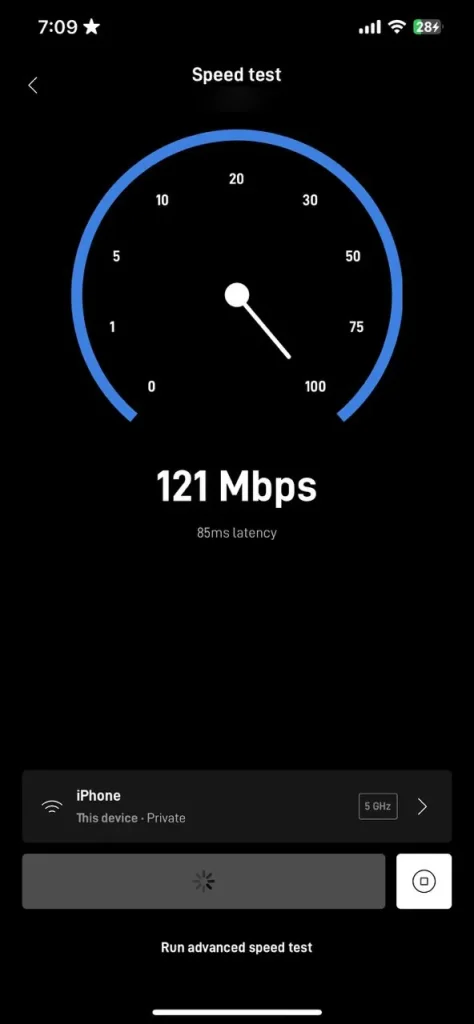
National figures are lower. Ookla’s Speedtest data, as reported in the Nigerian press, put Starlink’s median download in Nigeria below 50 Mbps in the first quarter of 2025, with about 60 ms latency, and Nigeria was still in Ookla’s “below 50 Mbps” group in the first quarter of 2026. A median takes in busy evenings, crowded areas, dishes with obstructions and phones on weak Wi-Fi, so it sits below what a well-placed dish shows on the day we install it. In that same 2026 data, Starlink still beat land-based internet providers on median download in 22 of 23 African markets.
Starlink’s standard terms, which we have not seen confirmed for Nigeria, say users typically get 45 to 280 Mbps download, 10 to 30 Mbps upload and 25 to 60 ms latency on land, and that speeds “may be lower than expected speeds during times of high usage”. Our guide to Starlink speed in Nigeria goes further into what to expect here.
Latency, the delay before data starts to move, matters more than raw speed for calls and gaming. Our installs measured 23 to 92 ms, which is comfortable for Zoom, Teams and WhatsApp calls. To see more real jobs, from estates to barges, browse our Starlink installations.
Why Starlink is good: the real advantages
- It works where fibre does not. Fibre and 5G reach only some cities and estates. Starlink needs a clear view of the sky, power and an active plan, so it works on farms, building sites, boats and in towns no cable reaches. Our installers cover all 36 states and the FCT.
- It is quick to set up. We usually install and activate in one visit of two to three hours, and activation is usually done about 30 minutes after payment.
- Unlimited data. Residential has no data cap, and on the Nigerian accounts we sell and manage, once a Priority plan’s priority data is used up, the service carries on with unlimited standard data at lower network priority. Blog claims of a “1TB cap” date from 2022-23 and are out of date; our article on whether Starlink is unlimited in Nigeria explains fair use and Priority data.
- The Mini is light on power. Starlink rates the Mini at 25 to 40 W on average, against 75 to 100 W for the Standard dish, so a modest inverter or solar set-up can carry it through a power cut.
- It is proven here. NCC data shows 98,642 Starlink subscribers in Nigeria in the second quarter of 2026, making it the country’s second-largest internet provider after Spectranet.
Why Starlink can be a bad idea: the honest drawbacks
- High upfront cost. Even the cheaper example above is ₦659,000 before you have used a megabyte.
- Prices follow the dollar. Starlink’s Nigerian prices have changed several times since launch in January 2023. The kit price climbed after the naira’s devaluation in 2024, and the Residential price rose by 50% in 2025. Budget for the possibility of another rise.
- Residential is closed to most new customers. Starlink’s home plan is not open to new customers in most locations, including Lagos, Abuja and Port Harcourt, so you pay for a Priority plan instead, which costs more each month. We check what is available at your address before you pay.
- It needs a clear view of the sky. Starlink says objects such as a tree branch, pole or roof in the way will cause service interruptions. Tall trees, water tanks and close neighbouring buildings are the usual problems.
- It needs constant power. There is no battery in the kit, and the Standard dish draws 75 to 100 W on average around the clock, so plan an inverter or solar backup.
- Busy-hour slowdowns. Starlink’s standard terms say Residential users are the most likely to be affected during peak usage hours, because Priority data gets precedence on the network. The same goes for a Priority plan once its priority data is used up.
- Support is mostly through the app. Starlink handles most support through tickets in the app and on starlink.com, and we know of no Nigerian Starlink phone line. Our guide to Starlink’s office and customer care in Nigeria explains the other options. Having a local installer matters when something goes wrong.
Is Starlink Residential or Roam worth it?
Residential is for one fixed address: a home, office or shop. It works only at the address registered on the account, and it has higher network priority than Roam, but it is closed to new customers in most locations. Roam is for people who move: site managers, field teams and travellers. It has the lowest priority on Starlink’s network, so it is first to slow when an area is busy, and the Nigerian press has reported that using Roam at a fixed home can lead to restrictions.
Our view: if you already have Residential, keep it. If you are buying now for one place, a Priority plan such as our small business plan is what is on offer, with higher network priority than Roam while its priority data lasts. Roam is worth it only when you genuinely move between locations. Our Starlink Roam guide covers the travel rules.
Who Starlink is worth it for, and who should choose fibre or 5G
| Your situation | Our verdict | Why |
|---|---|---|
| Home with no fibre on the street and weak 5G | Worth it | Usually the fastest connection you can actually get. |
| Office or shop that loses money when offline | Worth it, ideally with a second connection | Pair it with fibre or 5G so one covers the other. |
| Building site, farm, camp or boat | Strongly worth it | Few other options give broadband in these places. |
| Home on a street with good fibre, light use | Usually not | Fibre costs less each month and there is no kit to buy. |
| Tight upfront budget in a strong 5G area | Compare first | A 5G router costs far less upfront; check its data limits. |
| Renting short-term or moving often | Consider a Priority plan or Roam, or wait | Residential is tied to one address; a Local Priority plan can be used anywhere on land in Nigeria under Starlink’s standard terms. |
For a side-by-side with MTN’s home internet, read Starlink vs MTN 5G and Fibre X. For Airtel, Spectranet, Tizeti and others, see how Starlink compares with the alternatives. If you are choosing between kits, our Mini vs Standard comparison sets out the differences; in short, the Mini suits small flats and travel, while the Standard suits family homes and offices.
Not sure it is worth it at your address?
Send us your location before you spend anything. We check which Starlink plans are open at your address, look at where a dish would get a clear view of the sky, and tell you plainly if Starlink is the wrong choice. When you are ready, buy your Starlink kit from us with delivery, installation and activation in one visit. You pay on delivery in Lagos, Abuja and Port Harcourt, or 50% deposit elsewhere, by bank transfer. WhatsApp us or call 0802 859 5303, any time of day.
Starlink review FAQs
Is Starlink good in Nigeria?
Yes, where the dish has a clear view of the sky and steady power behind it. It is now Nigeria’s second-largest internet provider by subscribers, and our handover tests sit between 50 and 121 Mbps.
Is Starlink the fastest internet in the world?
No. Good fibre is faster, and some Nigerian fibre plans reach 1 Gbps in covered estates. Starlink’s strength is reach: it brings broadband to places fibre and 5G do not cover.
How consistent is Starlink internet?
With an unobstructed dish and an inverter behind it, it is steady from day to day. Expect slower evenings when the network is busy, and short drops if a tree or wall blocks part of the sky.
Is Starlink Roam worth it?
Only if you move around. For a fixed home or office, Residential (if you already have it) or a Priority plan has better network priority.
Does Starlink really give 100, 200 or 250 Mbps?
Our handover tests on the jobs above ranged from 50 to 121 Mbps, and none reached 200 Mbps. Starlink’s standard terms quote typical downloads of 45 to 280 Mbps, but in Nigeria we would plan for roughly 50 to 120 Mbps on a well-placed dish, expect less on busy evenings, and treat anything higher as a bonus.
Why do some people say Starlink is bad?
The usual complaints are the upfront cost, price rises, slower evenings, Residential being closed to most new customers and support that runs mostly through the app. Many speed problems come from obstructions or weak indoor Wi-Fi rather than the satellite link, and those can be fixed.